Scanning Thermal Microscopy
SThM
Thermal conductivity and temperature distribution imaging at the nanoscale using a nanothermal probe
What is SThM
(Scanning Thermal Microscopy)
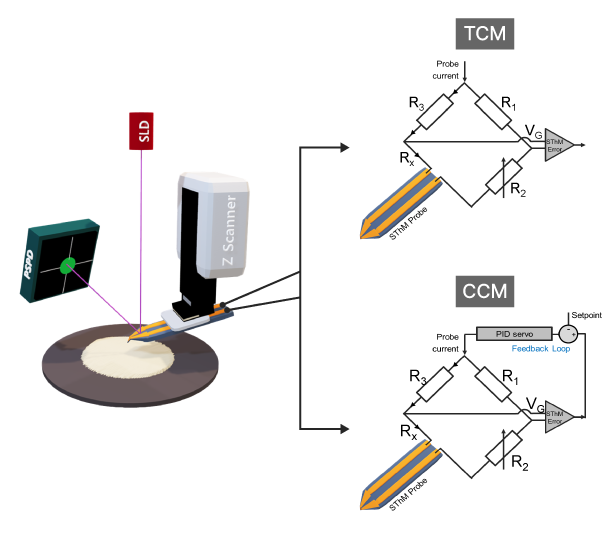
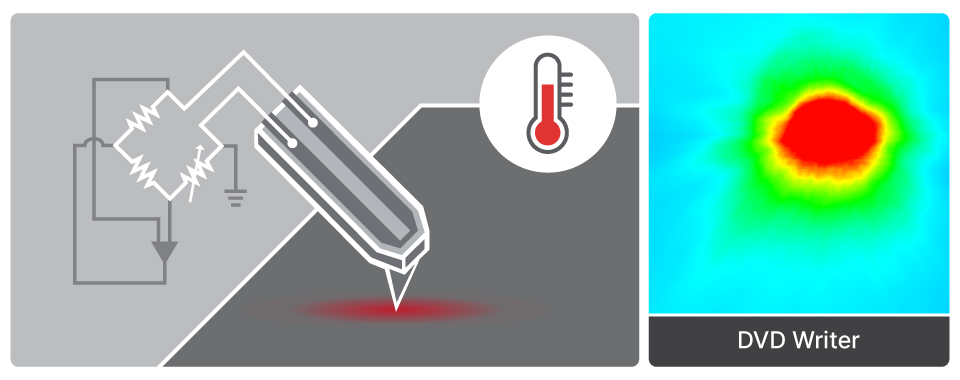
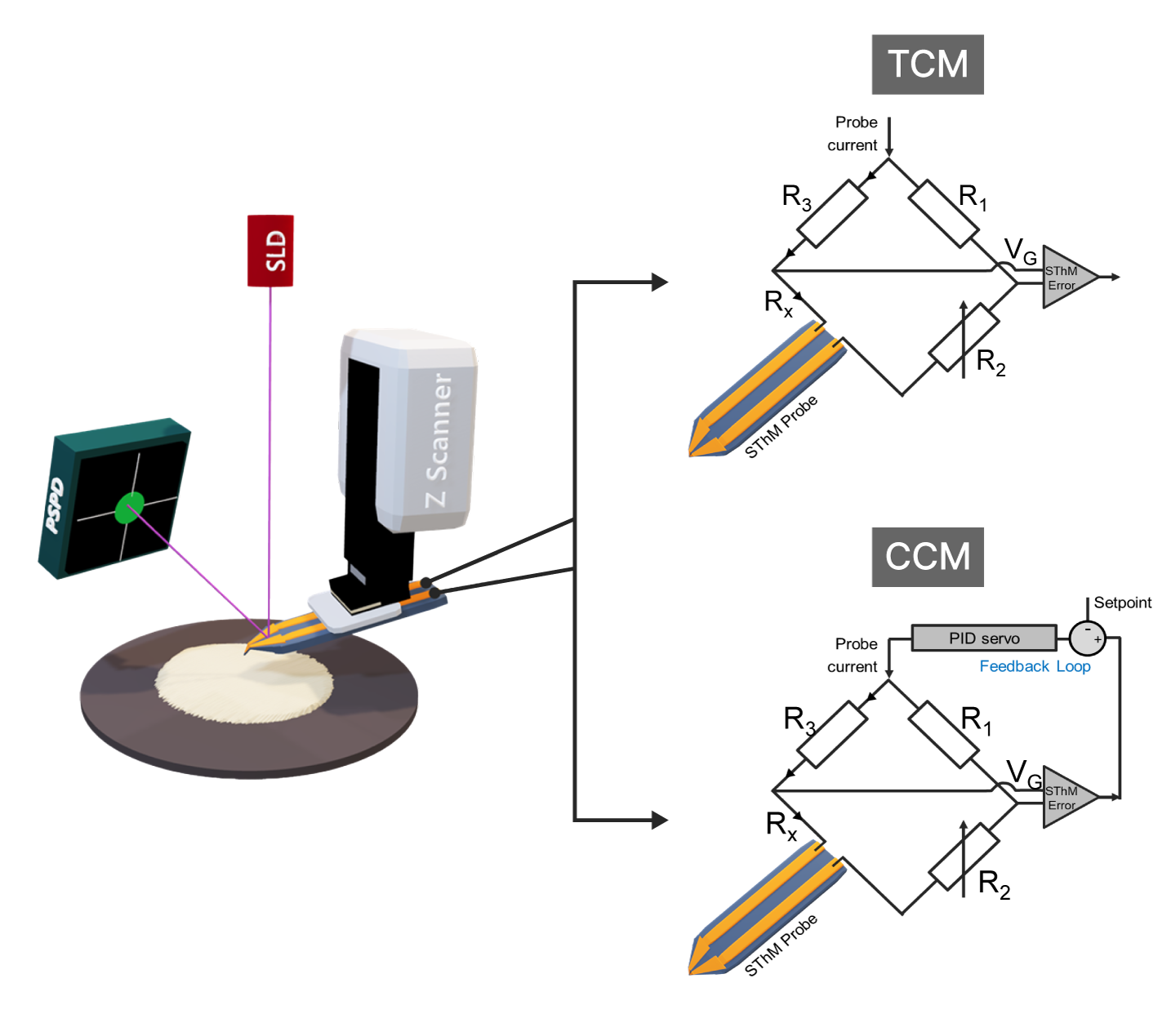
SThM measures local thermal properties and temperature changes via a specialized nanothermal probe integrated with a Wheatstone bridge circuit to resolve nanoscale heat transport behavior.
The core of this technique is a nanothermal probe. This probe is typically composed of a fine thermocouple or a thermistor that acts as a resistive thermometer. The probe tip maintains nanoscale contact with the sample surface, and its temperature changes sensitively according to the local temperature or heat transfer on the sample surface. This minute change in temperature leads to a change in the resistance of the material inside the probe. It is the role of the Wheatstone bridge circuit to precisely detect and measure this resistance change. The Wheatstone bridge converts the subtle resistance variation into a voltage signal, allowing the thermal signal to be captured with high sensitivity and stability. By utilizing the precise scanning mechanism of AFM to map the sample surface, SThM provides thermal property maps with a spatial resolution of tens of nanometers or less, which was impossible with conventional thermal measurement techniques.

There are two SThM modes: Temperature Contrast Mode (TCM) measures the heat transferred from a heated sample to the probe, translating the resistance change into temperature maps. Conductivity Contrast Mode (CCM) measures thermal conductivity via controlled probe heating and records tip heat loss to the sample. Both modes require a nanothermal probe, with the Wheatstone bridge circuit tracking resistance changes to maintain stable signal output.
TCM
When the tip is heated by sample, it leads increasing of SThM error (VG) in Wheatstone bridge by increasing of tip resistance (RX).
CCM
Probe current feedbacks to keep a constant SThM error (VG) signal. When the tip loses heat by the sample, probe current increases for SThM error feedback.
Reasons to Use This Mode
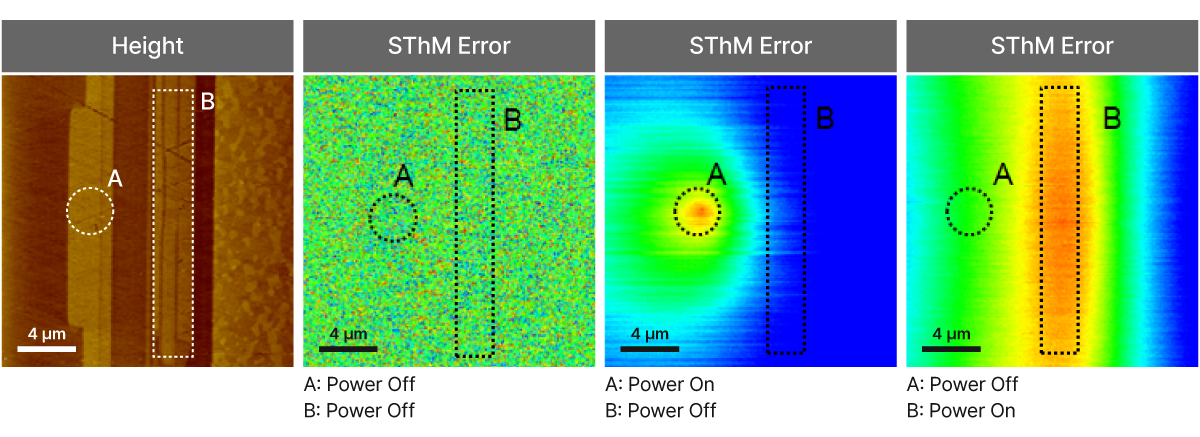
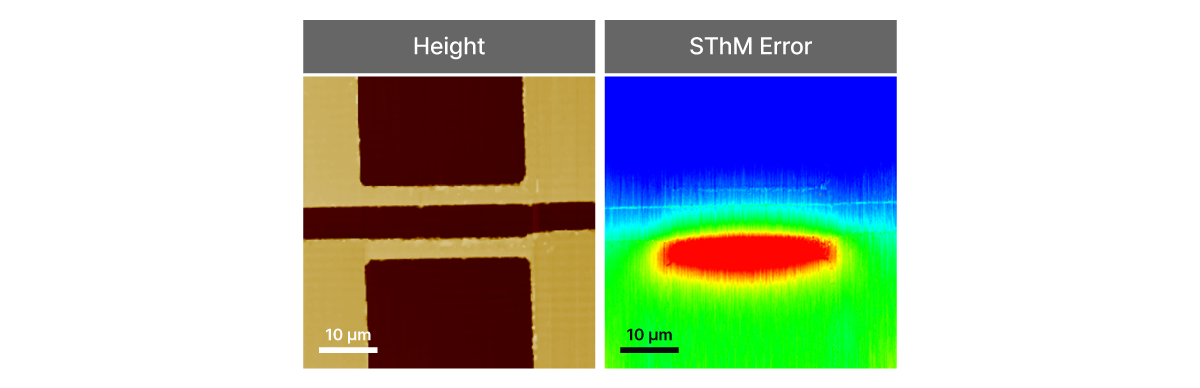
SThM enables high-resolution mapping of local thermal properties. By using a nanothermal probe, SThM visualizes heat dissipation pathways, hot spots, and nanoscale conductivity contrasts, critical for advanced materials and device engineering. The technique provides results with direct observation of thermal behavior at the level of nanostructures, interfaces, and defects. This facilitates analysis of phenomena such as phonon scattering, thermal transport anisotropy, and device self-heating, offering unparalleled insights for electronics, thermoelectrics, and energy applications. The figure exemplifies the strengths of SThM in localized thermal mapping. Power was applied to two distinct regions (A and B) in sequence, and SThM error images, recorded in TCM, revealed clear temperature elevation at the heated regions. This direct nanoscale visualization of thermal behavior demonstrates SThM’s ability to resolve heat dissipation and hot spots with high spatial precision, supporting advanced analysis of functional materials and device performance.
  • Sample: Pole-Tip-Recession of HDD Head
  • System: NX10
  • Scan Size: 20 µm × 20 µm
Applications and Use Cases
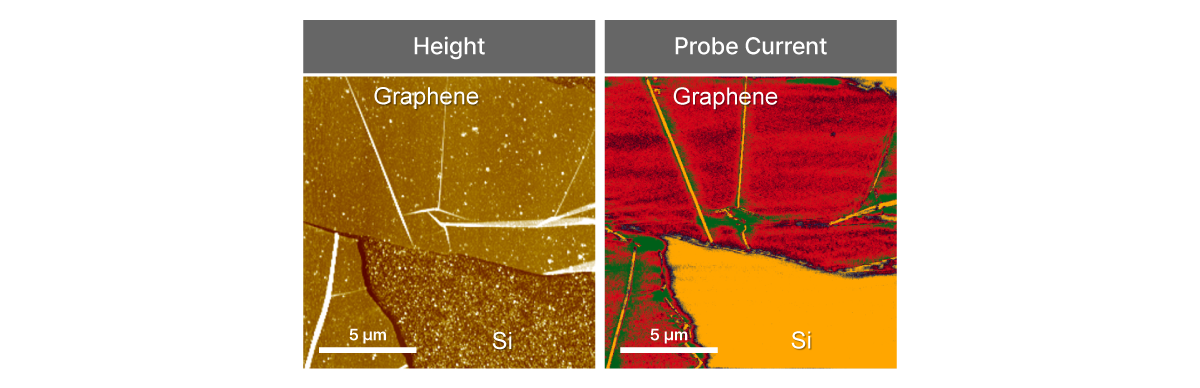
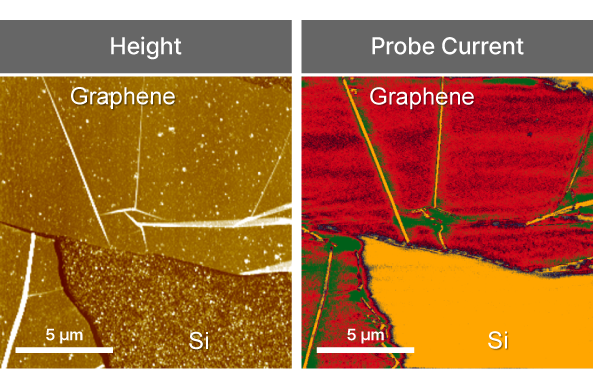
The figure demonstrates SThM’s capability to differentiate materials by nanoscale thermal properties. The graphene layer and underlying Si substrate are distinctly identified in both topography and probe current maps. SThM probe current reflects variations in thermal conductivity, allowing direct visualization of material contrasts.
  • Sample: Graphene on Si
  • System: NX10
  • Scan Size: 15 µm × 15 µm
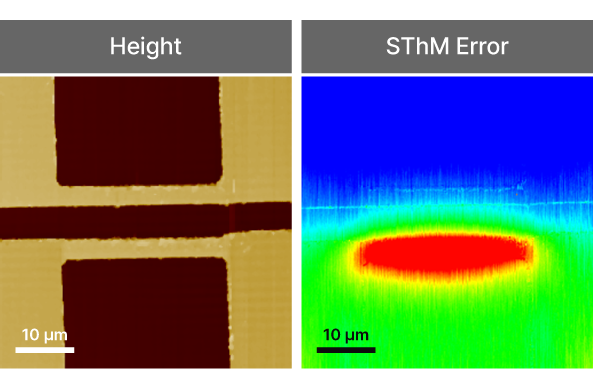
Visualizing thermal behavior in a metal heater structure by SThM is shown in figure. After applying 50 mA current to the metallic circuit, SThM error mapping in TCM reveals distinct temperature distribution, with hot spots corresponding to the heater region.
  • Sample: Metal Heater
  • System: NX20
  • Scan Size: 50 µm × 50 µm