Microwave Impedance Microscopy
MIM
Nanoscale electrical property mapping based on capacitance and conductivity changes
What is MIM
(Microwave Impedance Microscopy)
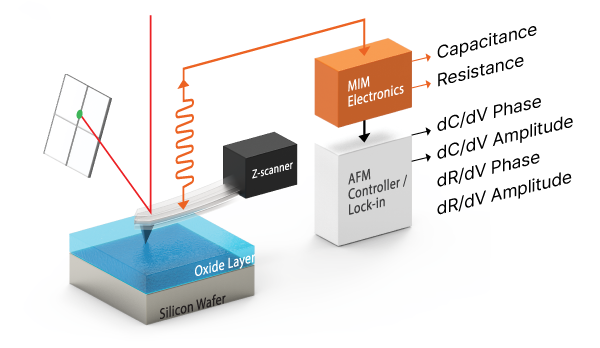
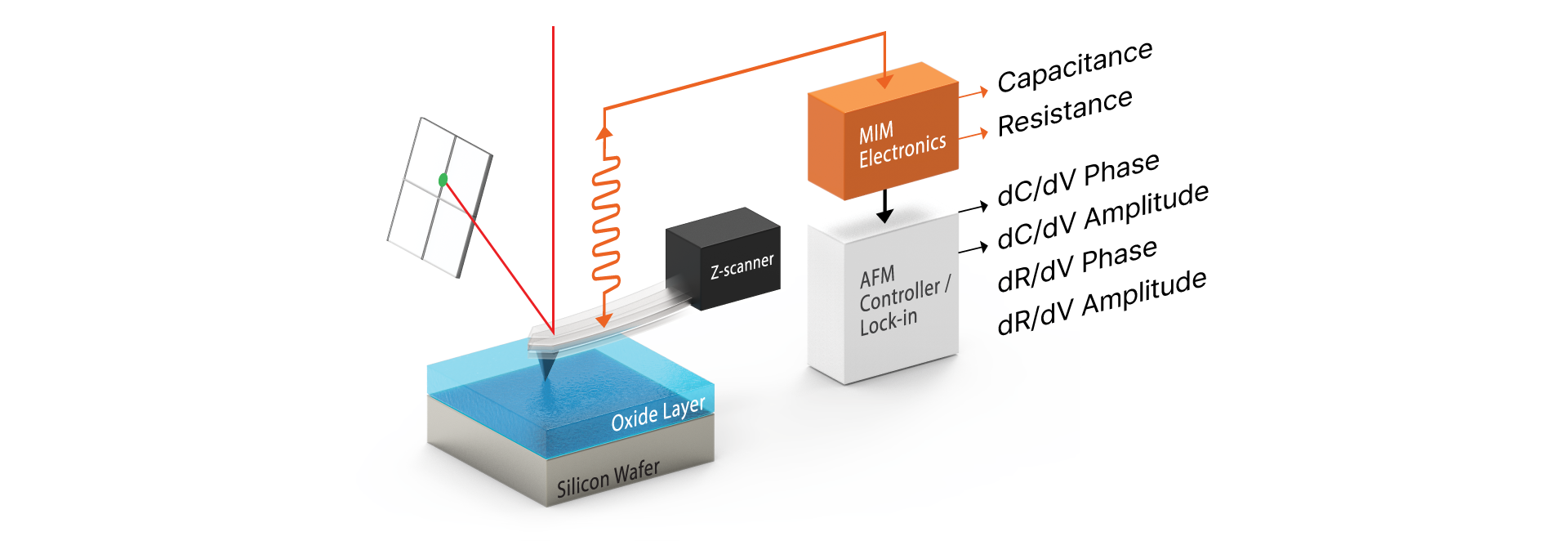
MIM measures local impedance (capacitance and conductance) by sensing the microwave signal reflected from the tip-sample interaction.
MIM operates by sending a microwave signal (usually ~3 GHz) through a specialized shielded AFM probe to a sharp metallic tip brought into close proximity to the sample surface. The near-field electromagnetic wave generated at the tip-sample interface interacts locally with the sample's electrical properties. The core of the measurement relies on analyzing the microwave signal reflected back up the probe. The reflected signal's phase and amplitude are directly related to the local tip-sample admittance (or impedance), which is in turn dependent on the sample's permittivity and conductivity. By rastering the tip, MIM simultaneously maps the resistive (in-phase) and capacitive (out-of-phase) components across the surface, providing detailed insights into various materials, including semiconductors, dielectrics, and 2D materials.
Reasons to Use This Mode
MIM allows electrical measurements on a broad range of sample types without the need for oxide layers, backside metallization, or external biasing. Techniques such as SCM or C-AFM typically rely on these conditions to function, which limits their use to specific device structures or prepared cross-sections. Because MIM operates through microwave interaction at the tip without requiring an electrical connection to the sample, it can be used directly on as-fabricated wafers, dielectrics, and insulating materials. This makes it especially useful for early-stage devices, sensitive films, and advanced materials that are difficult to prepare using conventional methods. MIM is widely used in semiconductor and materials research. It can map dopant distribution, evaluate dielectric film quality, and visualize local electrical behavior in emerging materials such as graphene, MoS₂, and hybrid organic–inorganic systems. The system is particularly useful for failure analysis, process monitoring, and advanced device characterization.
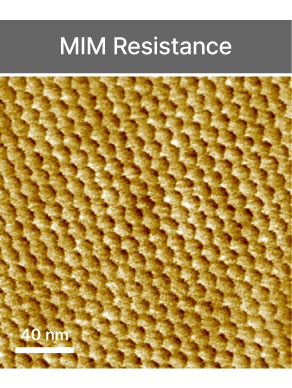
  • Sample: Layers of hBN-graphene-hBN
  • System: NX20
  • Scan Size: 200 nm × 200 nm
Applications and Use Cases
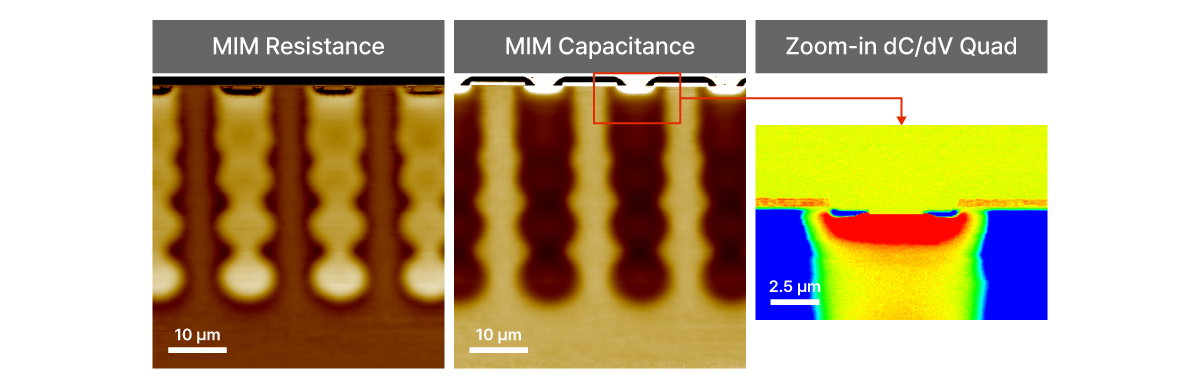
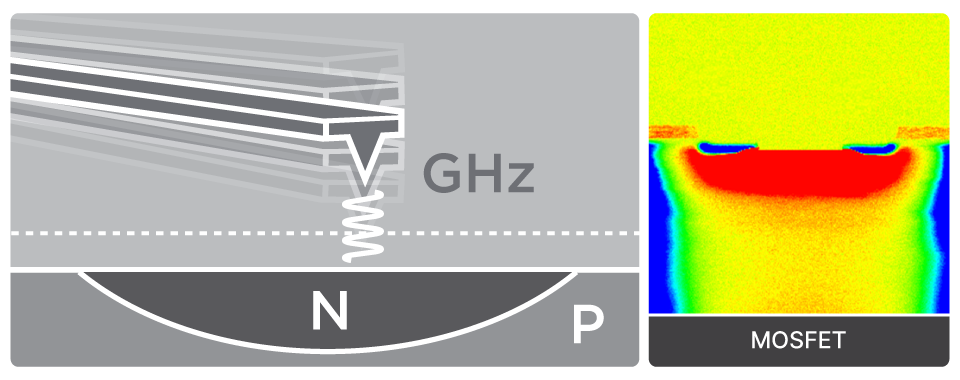
This set of images showcases a sample analyzed using MIM, an advanced AFM-based technique capable of mapping local electrical properties at the nanoscale. The left and center images represent resistance and capacitance contrasts, highlighting both geometric and material variations across the structure. The right image, a zoomed-in view of a selected region, displays the dC/dV Quad signal, which reveals fine variations in local dielectric and conductivity properties with high sensitivity. MIM simultaneously measures both capacitance and conductivity through microwave signals, enabling visualization of subsurface or hidden doping profiles and material interfaces without destructive cross-sectioning. This capability is particularly valuable for semiconductor device analysis and advanced materials characterization, allowing for detailed electrical property mapping directly correlated with surface morphology.
  • Sample: MOSFET
  • System: NX10
  • Scan Size: 50 µm × 50 µm, 15 µm × 10 µm
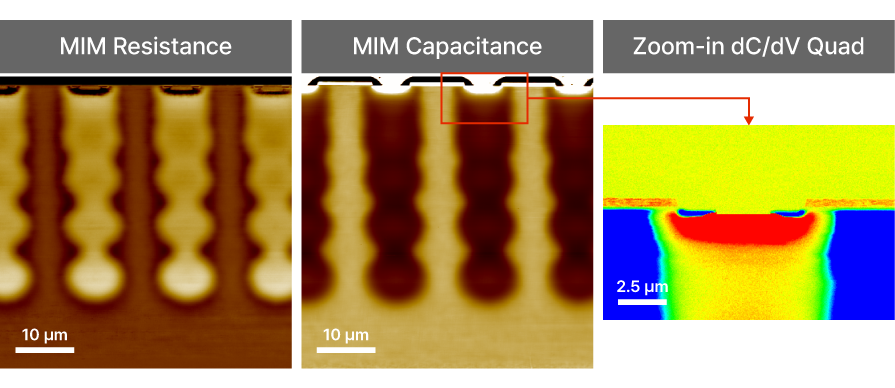
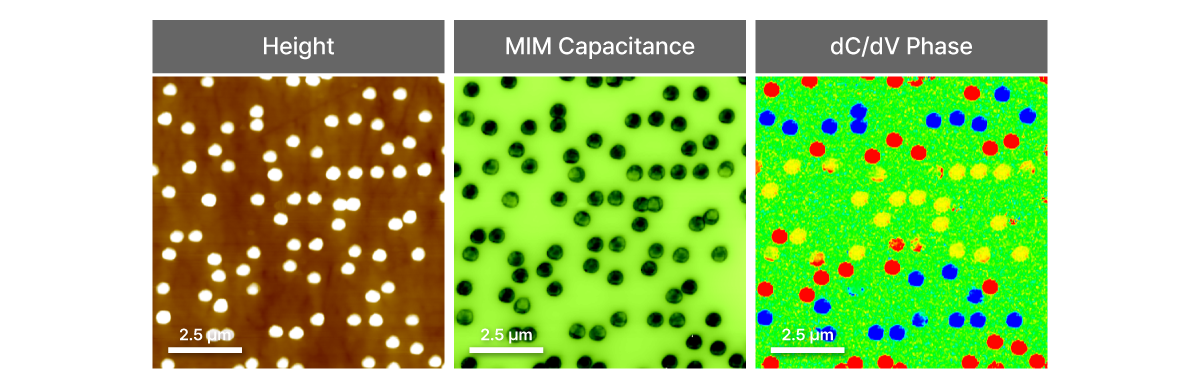
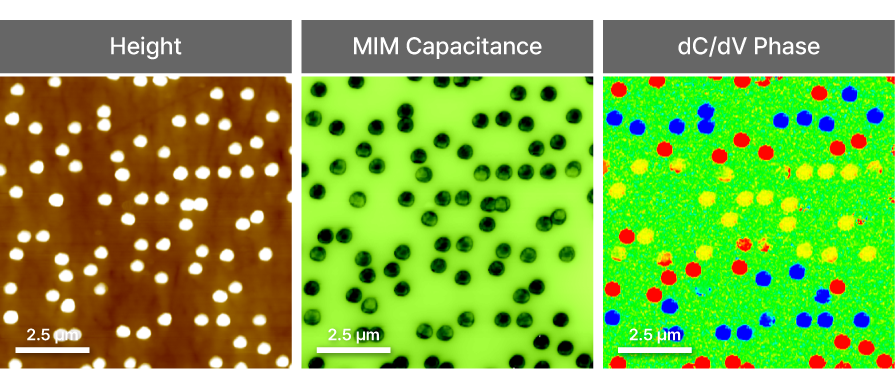
The results demonstrate the capabilities of MIM for semiconductor device analysis. Topography, MIM capacitance, and dC/dV phase maps of PMOS and NMOS plug regions reveal detailed subsurface electrical contrasts at the nanoscale. MIM enables non-destructive spatial mapping of local capacitive and electronic properties, distinguishing different device regions and variations in doping or material composition critical for advanced device characterization.
  • Sample: PMOS and NMOS Plug
  • System: NX20
  • Scan Size: 10 µm × 10 µm