Park FX40 IR is Park Systems’ advanced AFM solution for nanoscale infrared spectroscopy and imaging, combining chemical and surface characterization. It is built on the proven FX40 platform supporting small samples. With a low noise floor, minimal thermal drift, and enhanced mechanical stability, FX40 delivers unmatched precision and reliability.
Park FX40 IR is a nano-IR spectrometer based on Photo-induced Force Microscopy (PiFM), enabling both IR spectral analysis and chemical imaging at the nanoscale. Like all Park AFMs, it features an orthogonal scan system and True Non-contact™ mode, delivering consistent, non-invasive measurements even on fragile samples.
Automation features such as automatic probe exchange, IR beam alignment, and multi-point measurement streamline operation and simplify workflows.
Key Features
Superior FX Mechanical Design
Built on the superior FX-series AFM mechanical design, the FX40 IR is designed for minimal mechanical noise. The optical
microscope is decoupled from the Z stage, lowering the weight on the Z stage and thus reducing susceptibility to mechanical disturbances. The Z stage itself is built more robustly with a high-stiffness cross-roller guide and two bearing blocks. Constructed
with materials of low thermal expansion coefficients, the FX40 IR also minimizes thermal drift to ensure reliable long-term
performance.
The FX40 IR integrates dedicated components such as the IR laser, parabolic mirror actuator, multiplex box, and side steering
mirror, providing a stable platform for consistent nanoscale IR measurements
FX Laser Beam Path
The FX optics structure integrates a fiber-coupled laser (superluminescent diode; SLD)
into the optical microscope assembly. The laser beam is focused through the objective
lens and remains fixed at the center of the optical field of view.
Automatic Laser Beam Alignment
The vision-guided alignment system detects the cantilever shape and
position and then moves the optics XY stage to align the cantilever at the
center of the field of view, precisely where the laser beam is focused.
The focused beam has a reduced spot size, minimizing spillover and
unlocking compatibility with small, high-frequency cantilevers.
Automatic Probe Exchange
AFM probe exchange can be challenging, even for experienced users, often resulting in cantilever breakage. Park AFMs address this difficulty by using pre-aligned probe chip carriers with kinematic mounting points for reliable and consistent tip positioning.
Each chip carrier is marked with a QR code containing detailed information, including probe type, serial number, date manufactured, and specifications.
The FX head’s Z scanner features three precision ball seats for kinematic mounting, complemented by magnets at the base to ensure a secure, reliable, and repeatable mounting position.
The automatic tip exchanger (ATX) module stores up to 8 pre-mounted probes. After the ATX camera scans the probes' QR codes, the SmartScan™ AFM operating software displays probe information for each slot, allowing the user to select full or vacant probe slots with a simple mouse click.
After a slot is selected, the AFM head moves down to pick the probe up from or park the currently mounted probe into the slot, depending on the position of the strong magnet underneath.
Sample-View Camera
The sample-view camera provides a captured image of the sample, allowing users to simply point and click to move the XY stage. This enables convenient navigation to areas of interest and easy return to the same location.
Improved On-Axis Optics
The unobstructed optical microscope provides a clear field of view and resolves line widths down to 0.87 μm.
Reliable Nano-IR Analysis
Park FX40 IR builds upon the proven automation of the FX platform, including probe exchange and vision-guided AFM laser alignment, and extends this capability with advanced automation dedicated to IR measurements. In particular, the system features a fully automated IR beam alignment routine that uses the measured nano-IR signal as real-time feedback to locate the optimal beam position.
Automatic IR Beam Alignment Powered by SmartScan™
SmartScan™ performs automatic IR beam alignment. After executing a full-stroke scan using the parabolic mirror (PM) actuator, the FX40 IR automatically identifies the position where the measured nano-IR signal reaches its highest intensity. This ensures accurate alignment and maximizes signal quality with minimal user intervention.
Advanced Spectrum Analysis with SmartAnalysis™
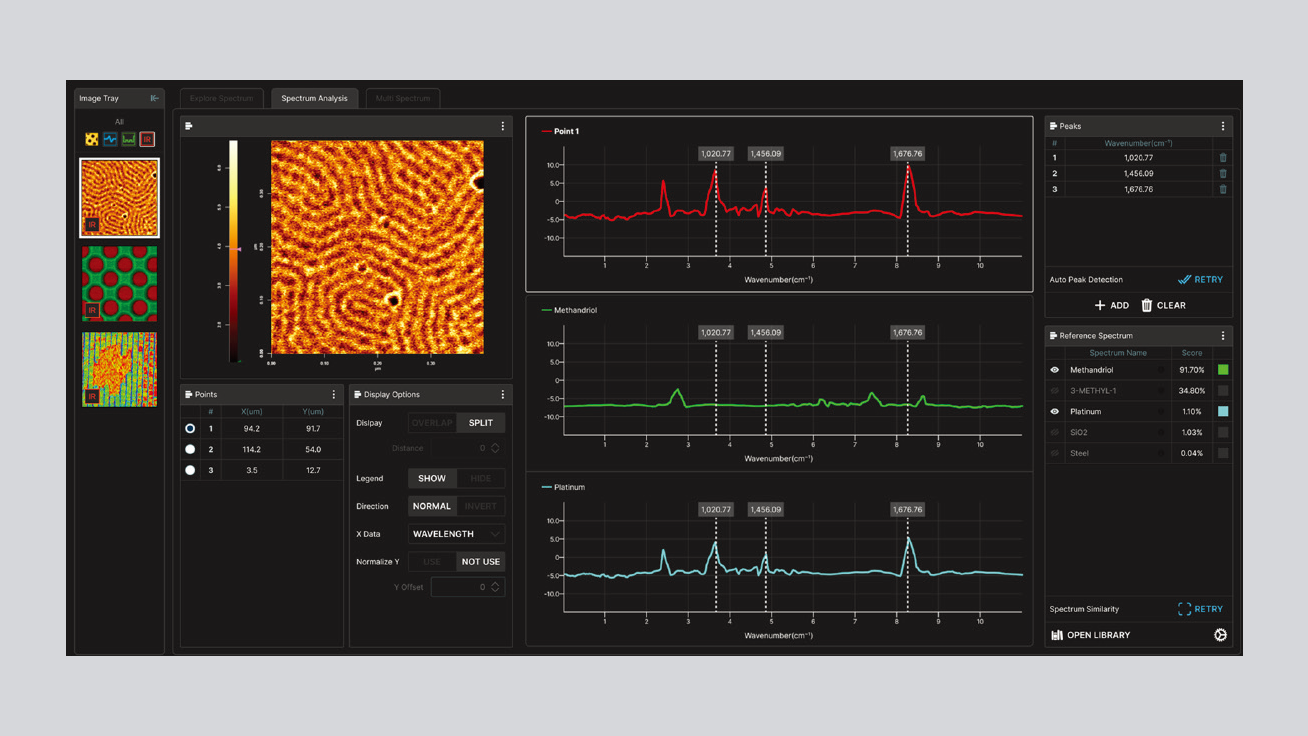
SmartAnalysis™ enables seamless spectrum visualization and image overlay for nano-IR data. Measurement results from SmartScan can be opened with a single click, displaying IR spectra alongside AFM images with chemical contrast overlays. This facilitates efficient interpretation of topographical and spectral information.
True Non-Contact™ IR Measurements
Park FX40 IR leverages Photo-induced Force Microscopy (PiFM) to perform fully non-contact infrared measurements, detecting the photo-induced force between the AFM tip and the sample without ever touching the sample surface. This approach eliminates sample damage and tip contamination inherent in contact-based techniques, achieving sub-5 nm spatial resolution and extending probe lifetime.
Non-contact mode feedback maintains precise tip–sample separation throughout the measurement, ensuring high reproducibility on soft or delicate materials. With streamlined operation, users can focus on results rather than setup, making nano-IR analysis more reliable and accessible than ever.
Selectable Detection Modes for Nano-IR
Measurements
Park FX40 IR offers two distinct detection modes, enabling users to optimize measurements based on sample characteristics and analysis goals. Direct mode tunes the laser to the cantilever’s resonance frequency, maximizing signal strength and making it effective for probing broader or deeper sample responses.
Sideband mode modulates the laser at the difference frequency (f1 − f0), selectively detecting nonlinear interactions at the tip–sample interface. This allows for highly localized chemical contrast with minimal background, ideal for resolving fine features on complex or heterogeneous surfaces.
Optimized Detection Frequency for Stable Nano-IR Imaging
Consistent, high-resolution nano-IR imaging requires more than just resonance. It requires precise frequency tracking. As the AFM tip scans across materials with varying mechanical properties, the tip–sample interaction can shift the cantilever’s resonance frequency. If not properly adjusted, this detuning may lead to signal degradation and mechanical artifacts.
Park FX40 IR addresses this by automatically scanning a narrow frequency range at every pixel and selecting the optimal detection frequency. This ensures the system stays aligned with the actual resonance condition throughout the scan, maintaining strong signals, reducing artifacts, and improving signal-to-noise ratio (SNR) for reliable chemical imaging on heterogeneous samples.
Park Advanced AFM Technology
Photo-induced Force Microscopy
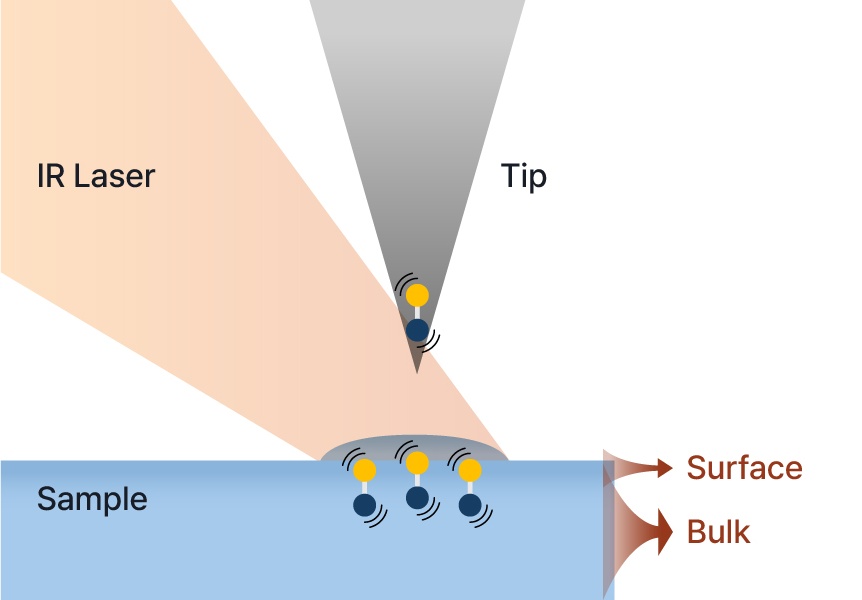
Photo-induced Force Microscopy (PiFM) detects photo-induced forces generated by resonant molecular vibrations excited with a tunable IR laser. In Park FX40 IR, the AFM cantilever operates in Non-contact™ mode to measure local IR absorption without touching the sample, enabling spectral and chemical mapping with sub-5 nm spatial resolution and monolayer sensitivity.
Park AFM Technology
Orthogonal Scan System
Conventional AFMs with tube scanners suffer from out-of-plane motion and axes crosstalk, resulting in image distortion, especially over large scan areas. The FX40 IR, like all Park AFMs, employs an advanced orthogonal scan system featuring a flexure-guided architecture: a 2D flexure scanner moves the sample in the XY plane, while a separate 1D flexure scanner independently controls the probe’s Z-axis motion. This separated scanner system ensures highly orthogonal, linear scans with minimal out-of-plane motion and fast dynamic performance. Equipped with low-noise optical sensors for XY feedback and an ultra-low-noise strain gauge sensor for Z control, a closed-loop servo control system ensures precise and repeatable scanning across all axes.
The XY scanner is designed to achieve flat, purely horizontal motion without vertical interference by using stacked piezo actuators and flexure hinge structures. A position sensor is located at the center of the scanner to provide direct feedback for servo control, minimizing positioning errors across the scan area. This design ensures consistent accuracy and stability, even when scanning large samples.
Flexible Upgrade Path
Future-Ready, On Your Timeline
Start with the FX40 (IR-upgradeable system) first, then expand to nano-IR capabilities later without changing platforms. A flexible upgrade path designed to adapt to evolving research priorities and investment plans.